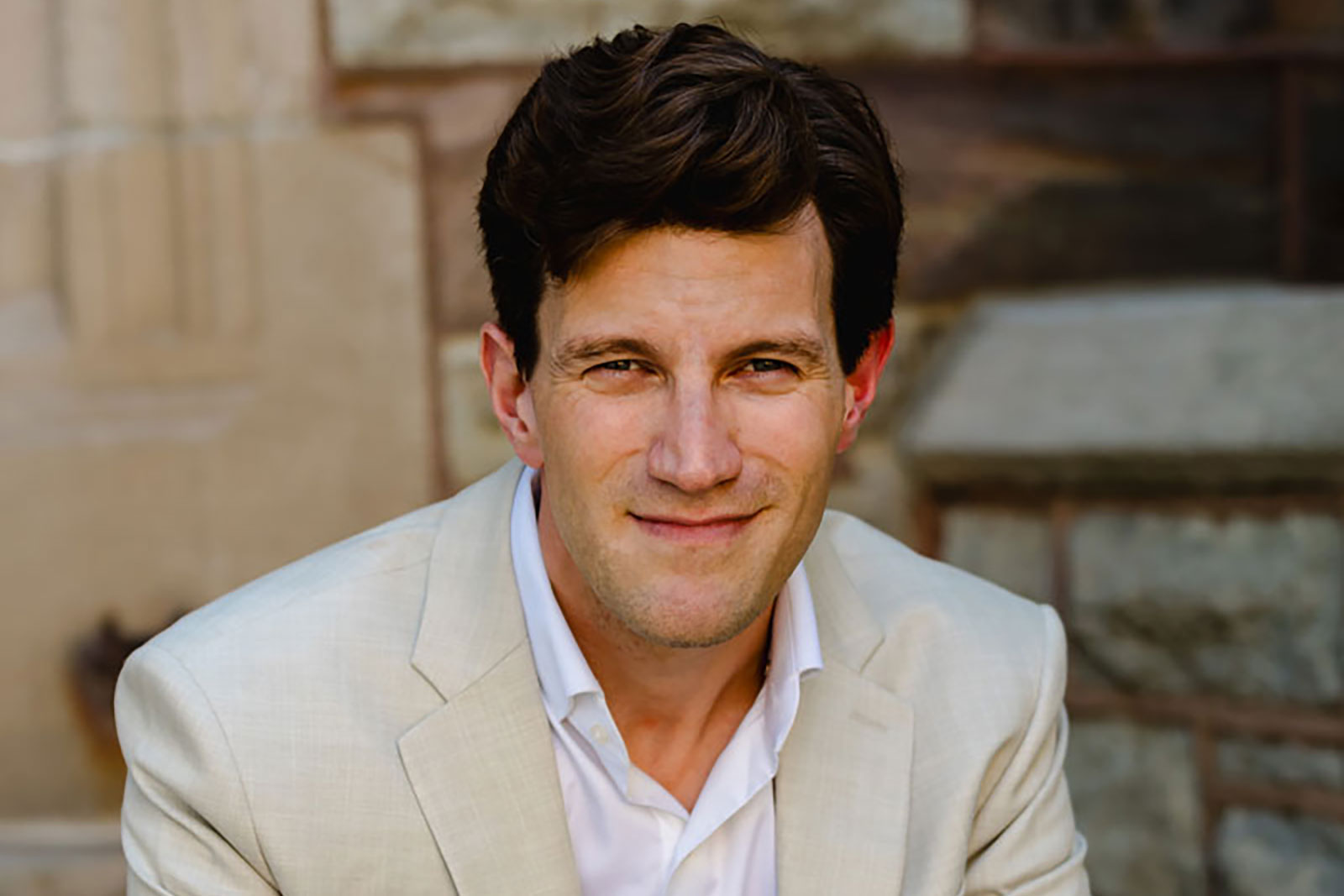
T hough he now oversees women’s health across nine hospitals and spends his days in operating rooms and delivery suites, Dr. Brian Tesler, ’06, still carries with him the unique perspective he gained as a nursing student at UM-Flint. That dual understanding of patient care has shaped the way he treats, teaches and leads — always mindful of the teamwork at the heart of health care.
“I like to say that I still keep my nursing cap with me in the pocket of my white coat. I think it’s given me the ability to see both sides of the bed,” he said, a skill that Tesler hopes to instill in the next generation of physicians. “In every position that I’ve been in teaching medical students or residents, I have required them to do a day with a nurse. They often don’t understand that when they put an order in, it’s not magic. Sometimes there are a lot of arguments in health care, but it’s not us versus them; it’s all of us for the patient.”
That commitment to understanding all sides of patient care and making sure everyone works together has been a defining thread in his journey from president of his nursing class at UM-Flint to an OB-GYN and chief medical director for women’s health at McLaren Health Care.
Although Tesler showed an early interest in pursuing a career in health care, it wasn’t until he was a department manager at a Meijer store. Recalling his initial inclination toward medicine, his path led to the nursing program at UM-Flint. As a lifelong resident of Flint, UM-Flint wasn’t just where he ended up earning a degree — it was where he began to truly understand his community.
”Being at UM-Flint gave me the room to shine, even though I was taking on a lot and carrying very heavy loads all the time.
Dr. Brian Tesler, ‘06

“The beauty of my nursing education at UM-Flint was that it helped me connect with my community in a new way,” he recalls. “I knew there were different needs in Flint, but it allowed me to actually participate in that and be part of it and engage with that. So it gave me a whole new view on my own community that I thought I knew well.”
While the university offered him new perspectives on a familiar landscape, it also gave him the support and space to grow into his potential. While a student, Tesler was president of his nursing class and president of the Council of Nursing Leadership, where he facilitated a shift from the original white scrubs to the navy blue version still worn by School of Nursing students today.
“Being at UM-Flint gave me the room to shine, even though I was taking on a lot and carrying very heavy loads all the time,” Tesler said.
And shine Tesler did, even receiving the Ellen A. Woodman Transformational Leadership Award in his senior year, a prestigious recognition only awarded when there is a unanimous decision among nursing program faculty. Today, it would seem that not much has changed.
“I’m that same person. My hobby is work. I just love being busy, working and doing — as long as I’m accomplishing something and making things better for someone or creating and innovating. But I think the ability to do that comes from the fact that I had such great support and great backing when I was at UM-Flint. So I really believed in myself and my ability to do the things I’m doing and not have a problem carrying a huge load.”
His heavy workload continued after graduation when he decided to apply to medical school while also working as a nurse. After being accepted and starting his education at Michigan State University, he continued working until his third year, picking up shifts in the ICU when he was not in class and then going home to study. Spending time in the hospital both as a nurse and on rounds, his motivation shifted from a general desire to help to something more specific in terms of his specialty.
“The thing we all say when we go to med school is ‘I want to help people,’ but as I got closer and closer to making my decision, it was about advocacy,” he says.
He considered pediatrics but ultimately chose obstetrics and gynecology, in part because he wanted to combine surgical skill with advocacy for a population whose needs are often overlooked.
“As a women’s advocate, I believe my job is to make sure I hear women and mold medicine to their needs and help protect what is important to them.”
In his current leadership role, Tesler is in a position to pursue that passion for medical advocacy, starting with a systemwide approach to women’s health.
“Our biggest goal, first and foremost, is making sure we’re providing the most evidence-based medicine possible as a system, making sure that our education and training for women’s health and women’s needs is the best it possibly can be,” he said. “So really taking more of a global look at what we need to be the best we possibly can be for our patients.”
He is also focused on addressing health inequities.
“Anyone working in maternal care, especially now, is focused on the morbidity and mortality. The rates are just outrageous for a country that has the most expensive and fanciest medical system in the world, and we can’t seem to fix it. But yet, we know it’s equity-driven. We know that there are very big differences between one person going in and having a baby and another person going in and having a baby based on their skin color or their background. So those are things that we want to address, and we’re trying to gear our education towards making sure we’re doing the best we possibly can in those areas.”
One of Tesler’s key initiatives is the OB Midwifery Access Program (MAP), designed to expand maternal care in rural and underserved areas. When he visited McLaren’s nine labor and delivery hospitals, their necessity was clear. In many cases, they serve a population with no other choice when it comes to medical care. Some patients already drive more than 45 minutes just to reach one of McLaren’s centers, so the option for other alternatives does not exist.
With his nursing background, Tesler recognized the benefit of certified nurse midwives, especially in these more rural areas where access to care was more difficult.
“We know that if we get nurses and midwives in place, especially in these very rural places or other places, they provide a connection to the community that is different and unique for them. They create a feeling of safety. They create a feeling of engagement with communities that we often can’t see with just doctors or hospitals. It’s also proven in studies over and over again that they decrease C-sections, they increase safety in obstetric units, and they decrease morbidity and mortality.”
The program has been piloted in Flint, where they’ve seen a recent rise in birth rates, but ultimately, his vision for innovation goes beyond programs.
“I want to continue to find ways for medicine to meet people where they are. I want to find ways to innovate that allow patients not to spend hours of their day in an office for things that can easily be done in different ways. I want to really connect medicine with the community here. I don’t want patients to feel like medicine is happening to them. I want them to feel like they’re part of their care.”
For Tesler, the desire to innovate and influence the future of health care does not end with himself but extends to the impact he is able to have on the next generation of medical professionals.
“I love to invest in people,” Tesler said. “So many younger people out there have stories similar to mine. They need somebody to believe in them, and they need somebody to value them, and that’s why I say invest. I see the value in those people, and I see the value in their dreams.”
Part of the investment Tesler makes in the future of medicine is through OB/GYN Board Prep®, the leading OBGYN board review course in the nation, of which he serves as co-owner and Chief Educator. Tesler sees his work in helping doctors prepare for their board exams as an extension of the way he contributes to and helps to shape the future of medicine – a future he hopes departs from the current status quo.
“We have to do better at investing in our next generation of medicine and teaching them early on that they can change things, they can move things forward. Medicine needs people to think differently. It needs people to innovate differently. It needs us to realize that it was never a system that really worked, and if we stay caught up in what it is, we aren’t able to start picturing it as something better and different. So what I say to medical students early on is, I am counting on every single one of you. Don’t just answer your inbox; go shake up the system.”
Dr. Brian Tesler’s path — from UM-Flint nursing student to physician-leader — is proof that advocacy, innovation and deep community roots can transform health care. Whether he’s speaking up for women’s health, reimagining care delivery or investing in the next generation of providers, he’s guided by the same values he carried from his days in Flint: resilience, collaboration and a steadfast belief that medicine works best when it truly works for people.
If you would like to learn more about Dr. Tesler’s work with OB/GYN Board Prep®, visit obgynboardprep.com.
Christina Blitchok is the Director of Campaign Initiatives & Alumni Engagement at UM-Flint. In her role, she partners with graduates to deepen their connection to the university, helping them write the next chapter of their Michigan story through philanthropy, volunteerism, and meaningful engagement. She can be reached at andersch@umich.edu.